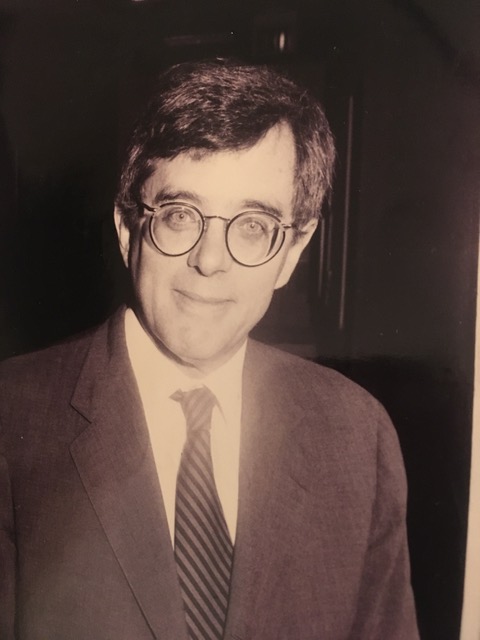
Roughly speaking, since studying at Harvard ‘64, Oxford and Yale M.Phil, Ph.D 1971, the inquiries I press forward in teaching, conversing, and writing address three matters: the rivalry of philosophy and poetry, the relation of reason and revelation, and the quarrel of the ancients and the moderns. Among my many superior companions, most helpful have been and are: Plato, Montaigne, Nietzsche, the Bible, Rembrandt, Pascal, Tolstoy, and Shakespeare, Shakespeare for the longest time.
Long stretches with fine students at Dartmouth, where I proposed a liberal arts honors program, and with ardent students at the University of Dallas, which already had such a liberal arts core, have advanced my inquiries, as also classes with honors students in Texas, in Wyoming, in Virginia; and in Germany during my Humboldt year in Heidelberg with Gadamer and later in Greifswald for three summer semesters. In all I’ve taught in some five “departments” of the modern university, mainly literature, philosophy, and statesmanship, but also the likes of Rembrandt, biomedical ethics, Churchill, and Texas government.
Beginning in 1998, I taught at George Wythe College, on the high, sage-brushed plains, between Zion and Bryce Canyons. Founded by Oliver DeMille, then in his 20s, its great and good books curriculum emphasized statesmanship, as would please George Wythe. Around 2006, when my friend Shane Schulthies became president I began to teach more (as we together raised standards and strengthened the curriculum). In its last years, before it perished, I taught a great deal: Shakespeare’s Histories: Hamlet and Lear; Manzoni’s Betrothed; Pascal, Kierkegaard, Nietzsche, and Heidegger; Herodotus and Thucydides; Racine, St. Simon and Goethe’s Faust; the Republic; the Emile; and Zarathustra; a special course on the Teenager; one on Rembrandt; and a graduate course in Philosophy of Education (Bloom, Barzun, Newman, and Rousseau).
Then with a remnant of students, and others, especially old students of mine from elsewhere, I pressed on over the internet with Zoom, one fall delivering my Seven Wonders of Shakespeare, which St. Augustine Books will publish, and one spring, the matter of my book mss The Teenager and the West, which Roger Scruton offered to write a preface for. Several years ago we shared Hamlet and Lear for a term, then the Comedies, and then the Histories. Then Machiavelli, More, and Erasmus. Nietzsche and Goethe’ Wilhelm Meister. And just before the virus came roaring out of Wuhan, Manzoni’s The Betrothed. Last winter we took a “Western Swing” with Owen Wister’s Virginian and some of his “sons,” Shane, Liberty Valance, and Marshall Kane. This spring it was all of Montaigne. Summers vary; one year we read the anonymous Bandi’s stories about North Korea, truly a firefly in that darkness. Another summer it was Don Quixote, which we loved so much we look to again in 2023. And another summer, Magic Mountain. Some summer it will be War and Peace for whoever 20, among friends, children, and former students want to meet the mighty Tolstoy.
As ever class days are the best days of my week! And the anchor of the rest. Time now to finish books, the fruit of all my days teaching. One, Mighty Opposite: Machiavelli and Shakespeare Match Wits just appeared on Amazon. Next is Seven Wonders of Shakespeare from St. Augustine Books. Others, on Rembrandt, on the novelty of the “Teenager,” and The Declaration and Constitution: Two Wings for Humanity, advance.
In the States you can reach me, in winters at 1275 Knopp School Rd. Fredericksburg, Texas 78624 and in summers at 1158 Bixby Road, East Wallingford, Vermont 05742; cell phone: 830-998-9092, but emails best: drmichaelplatt1942@gmail.com
 Friends Of The Republic